

Last updated on May 8th, 2026 at 07:58 pm
The tentative meaning often confuses people because it sits in a gray area between “yes” and “no.” When something is tentative, it isn’t final, confirmed, or fully decided yet.
People search for the meaning of tentative to better understand conversations, appointments, plans, or messages where certainty is missing. You’ll see this word frequently in texts, emails, meetings, and even on social media especially when someone wants flexibility or room to change their mind.
Understanding the tentative meaning helps you avoid misunderstandings, missed expectations, and awkward follow-ups. In simple terms, tentative signals possibility, not promise. This article breaks down the word clearly, shows how it’s used across chats and platforms, and explains how to respond naturally when someone uses it.
What Does Tentative Mean in Text & Chat?
In text and chat conversations, the tentative meaning usually implies uncertainty or a plan that may change. When someone says something is tentative, they are intentionally avoiding full commitment. This is common in casual conversations, work chats, and scheduling messages where flexibility is needed.
People often use tentative to sound polite, cautious, or realistic. Instead of saying “yes” or “no,” they choose a softer response that leaves options open. This can reduce pressure and prevent disappointment if plans don’t work out.
Common chat interpretations:
- The plan is not final
- Confirmation will come later
- Circumstances might change
- The person is unsure or waiting
Quick examples:
- I’m tentative about dinner tonight 🍽️
- Friday is tentatively booked
- The meeting time is tentative
In chat, tone matters. Tentative messages are usually neutral and calm, not negative. They don’t mean rejection—just uncertainty. Understanding this helps you reply appropriately instead of assuming disinterest or avoidance.
Full Form, Stands For & Short Meaning of Tentative
The word tentative does not have a full form or acronym. It is not slang or an abbreviation. Instead, it’s a standard English adjective and adverb (tentatively) used across formal and informal communication.
Short meaning:
Tentative = not final, uncertain, or subject to change
Related word forms:
- Tentative (adjective): a tentative plan
- Tentatively (adverb): tentatively agreed
- Tentativeness (noun): lack of certainty
Unlike internet abbreviations, tentative keeps the same meaning everywhere. Whether used in a business email or a WhatsApp chat, it always signals temporary agreement or uncertainty.
This consistency makes it a useful word—but also one that requires context. Without context, tentative statements can feel vague, which is why people often ask what the tentative meaning really implies.
Tentative Date Meaning

A tentative date refers to a planned date that is not yet final or confirmed. It is set temporarily and may change depending on availability, decisions, or further confirmation.
Examples:
- The wedding has a tentative date in June, but it may shift based on venue availability.
- We scheduled a tentative date for the event until all guests confirm.
- The company announced a tentative date for the product launch, subject to delays.
Tentative Meaning in Meeting

In the context of a meeting, tentative means something that is proposed but not officially confirmed. It often applies to meeting times, agendas, or decisions that are still open to change.
Examples:
- The meeting is tentative for Monday morning until everyone confirms their availability.
- We created a tentative agenda that can be adjusted during the discussion.
- The manager gave a tentative approval pending further review.
Tentative Meaning in English
The word tentative in English describes something that is uncertain, not definite, or done with hesitation. It can refer to plans, decisions, or actions that may change later.
Examples:
- She made a tentative decision to move abroad next year.
- His answer was tentative, showing he wasn’t completely sure.
- The project timeline is still tentative and may be revised.
Tentative Meaning Tagalog
In Tagalog, the word tentative can be translated as “pansamantala” or “hindi pa tiyak,” which means temporary or not yet certain. It describes something that is still subject to change.
Examples:
- Ang petsa ay pansamantala pa lamang at maaaring magbago.
- Mayroon kaming tentative schedule para sa meeting bukas.
- Ang desisyon ay hindi pa tiyak habang hinihintay ang approval.
Origin, History & First Known Use of Tentative
The word tentative comes from the Latin word tentare or tentativus, meaning to try, test, or attempt. Its earliest known use in English dates back to the 17th century, where it described actions done experimentally rather than conclusively.
Originally, tentative was used in academic and scientific contexts to describe theories or results that were not yet proven. Over time, the meaning expanded into everyday language, where it began describing plans, decisions, and opinions that were open to revision.
Historical shift:
- Early use: experimental or trial-based ideas
- Modern use: flexible plans and uncertain decisions
This evolution explains why tentative still feels cautious and careful today. The word carries a built-in warning: this may change. That’s why it remains popular in professional, educational, and digital communication.
How People Use Tentative in Daily Conversations

In daily life, the tentative meaning appears most often when people talk about plans, schedules, or decisions. It allows speakers to stay honest without sounding unreliable.
People use tentative when:
- Waiting for confirmation
- Depending on other factors
- Avoiding overpromising
- Keeping options open
Everyday examples:
- My travel dates are tentative
- We have a tentative plan for Sunday
- I’m tentative about joining the call
This word is especially common in workplaces, schools, and social planning. It communicates transparency while maintaining flexibility—a social skill that helps manage expectations.
What Does Tentative Mean?
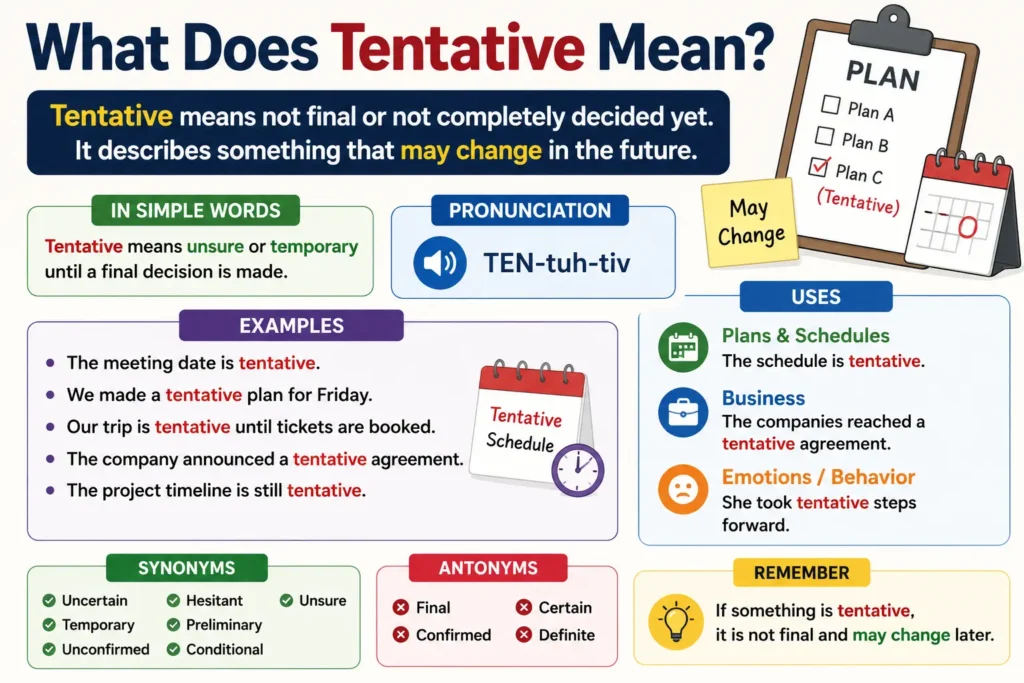
Tentative means not final or not completely decided yet.
It describes something that may change later.
👉 Example:
“We made a tentative plan for Friday.”
This means the plan is not fully confirmed.
Tentative Meaning in Simple Words
In simple English, tentative means unsure or temporary until a final decision is made.
It is often used for:
- Plans
- Decisions
- Dates
- Ideas
- Arrangements
Tentative Pronunciation
The word tentative is pronounced as:
👉 TEN-tuh-tiv
Tentative Meaning With Examples
Example 1
“The meeting date is tentative.”
👉 Meaning:
The meeting date is not final yet.
Example 2
“She gave a tentative answer.”
👉 Meaning:
She answered with uncertainty.
Example 3
“We have a tentative travel plan.”
👉 Meaning:
The travel plan may still change.
Tentative Sentence Examples
- The schedule is tentative for now.
- We made tentative arrangements for dinner.
- His tentative smile showed nervousness.
- The company announced a tentative agreement.
- The project timeline remains tentative.
Tentative Meaning in Business
In business, tentative often means:
👉 A proposal or plan that is not fully approved yet.
Example:
“The companies reached a tentative agreement.”
This means the agreement is still awaiting final confirmation.
Tentative Meaning in Daily Life
People use tentative in everyday conversations for:
- Travel plans
- Event dates
- Appointments
- Personal decisions
👉 Example:
“Our trip is tentative until tickets are booked.”
Tentative Meaning in Emotions
Tentative can also describe behavior that seems:
- Hesitant
- Careful
- Unsure
👉 Example:
“She took tentative steps forward.”
Meaning:
She moved carefully and uncertainly.
Tentative Synonyms
Here are common synonyms of tentative:
- Uncertain
- Temporary
- Unconfirmed
- Hesitant
- Conditional
- Unsure
- Preliminary
Tentative Antonyms
Opposite words of tentative include:
- Final
- Confirmed
- Certain
- Definite
- Permanent
Common Mistakes When Using Tentative
❌ Thinking Tentative Means Weak
Tentative only means not fully decided yet.
❌ Confusing Tentative With Temporary
Something tentative may become permanent later.
❌ Using Tentative for Confirmed Plans
Tentative should only describe uncertain situations.
Tentative Meaning for Kids
For kids, tentative means:
👉 “Not fully decided yet.”
Kid-Friendly Example:
“Our picnic plan is tentative because it may rain.”
Tentative Meaning Across WhatsApp, Instagram, TikTok & Snapchat
Across social platforms, the tentative meaning stays the same but feels more casual. On WhatsApp or Instagram DMs, it often replaces long explanations.
Platform-style usage:
- WhatsApp: Tentative for now 👍
- Instagram: Tentative plans, will update
- TikTok comments: Tentative collab 👀
- Snapchat: Tentative meet-up tonight
On social media, tentative is often paired with emojis to soften the uncertainty. It signals openness rather than hesitation. Users rely on it to stay non-committal without ghosting or rejecting.
Different Meanings of Tentative in Other Fields
While the core meaning stays consistent, tentative takes on slightly different shades depending on the field.
Field-specific meanings:
- Business: pending approval or review
- Medicine: not fully diagnosed
- Law: provisional or subject to change
- Education: draft schedules or syllabi
- Science: unconfirmed results
Despite context changes, the foundation remains the same—nothing is final yet.
Common Confusions, Mistakes & Wrong Interpretations
Many people misread the tentative meaning as disinterest or avoidance. This leads to unnecessary frustration.
Common mistakes:
- Assuming tentative = no ❌
- Thinking it’s vague on purpose
- Expecting instant confirmation
Tentative simply means waiting. It’s a pause, not a rejection.
Similar Terms, Alternatives & Related Slang
Words similar to tentative include:
- Provisional
- Conditional
- Unconfirmed
- Subject to change
- Possibly
Slang-style alternatives:
- Maybe-ish
- Not locked in
- Up in the air
Internal linking suggestion:
Link to related pages like provisional meaning, TBD meaning, or pending meaning.
Examples of Tentative in Real Chat Situations

- Plans are tentative right now 🙂
- I’m tentatively free after 6
- The date is tentative, don’t book yet
These short examples help readers quickly grasp real usage.
How to Reply When Someone Says Tentative
Good replies acknowledge uncertainty without pressure.
Natural responses:
- Got it, keep me posted 👍
- No worries, let me know later
- That works for now 😊
Matching their tone keeps communication smooth.
Is Tentative Still Popular? Trends & Online Usage
Yes—tentative remains widely used and beyond. With flexible work, remote plans, and fast-changing schedules, the word fits modern communication perfectly. Searches for tentative meaning continue to rise because clarity matters more than ever.
FAQs:
1. Does tentative mean yes or no?
Neither—it means maybe.
2. Is tentative negative?
No, it’s neutral and practical.
3. Can tentative plans change?
Yes, that’s the point.
4. Is tentative formal?
It works in both formal and casual settings.
5. How long can something stay tentative?
Until confirmation or cancellation.
Conclusion:
Understanding the tentative meaning helps you communicate more clearly and avoid confusion in both personal and professional conversations.
The word doesn’t signal rejection or indecision it simply reflects honesty about uncertainty. In a fast-moving digital world, being tentative is often smarter than being absolute. Whether you see it in a text, email, or social post, remember that tentative means flexible, not final.
Once you recognize this, you can respond calmly, set better expectations, and keep conversations flowing smoothly. Knowing how and when to use tentative gives you better control over communication—and fewer misunderstandings overall.

Benjamin is a name that means “son of the right hand” in Hebrew. People with this name are often known for their intelligence, kindness, and strong character. Benjamin is usually curious and loves learning new things. He works hard in school and enjoys solving problems. He is also loyal to his friends and family, and people trust him because he is honest and helpful. As an adult, Benjamin may choose a career in science, business, or art, where he can use his skills and creativity. Overall, Benjamin is seen as a smart and reliable person.