
Last updated on May 8th, 2026 at 08:08 pm
The word obliterated meaning often pops up when people want to understand a strong, dramatic term used in everyday speech or online chats.
People search for it because it sounds intense, and they want to know if it refers to physical destruction, emotional overwhelm, or simply being “totally wiped out.” Whether you saw it in a text message, a meme, or a TikTok caption, obliterated is used in different ways depending on context.
In this article, we’ll break down the obliterated meaning clearly and simply. You’ll learn how it’s used in real conversations, what it means across social media platforms, and common mistakes people make. Let’s explore this word in a friendly, easy-to-understand way.
What Does “Obliterated” Mean in Text & Chat?
When someone says they are obliterated, they usually mean they are completely exhausted, overwhelmed, or emotionally destroyed. In casual chat, it’s often used to exaggerate how tired or shocked someone feels.
Common Chat Meanings
- Totally exhausted: “I’m obliterated after that workout.”
- Emotionally overwhelmed: “I’m obliterated by that story.”
- Completely destroyed (joking): “He obliterated me in the game.”
Quick note: In chats, obliterated is mostly slang and is rarely used literally.
Full Form, Stands For & Short Meaning of “Obliterated”
Unlike abbreviations, obliterated is a full word. It doesn’t stand for anything.
Short Meaning
- Destroyed completely
- Wiped out
- Erased
Simple Definition
Obliterated means something is removed or destroyed so completely that nothing remains.
Origin, History & First Known Use of “Obliterated”
The word obliterate comes from Latin oblitterare, meaning “to erase from letters.” It first appeared in English in the 1500s.
Historical Use
Originally, it was used in writing and official documents to describe erasing text or evidence.
Modern Use
Now, obliterated is used in everyday speech, especially in casual or dramatic contexts.
How People Use “Obliterated” in Daily Conversations
In real life, obliterated is often used to describe feelings or situations that feel intense.
Examples in Daily Talk
- After a long day: “I’m obliterated, I need sleep.”
- After a breakup: “I feel obliterated emotionally.”
- After a challenge: “That exam obliterated me.”
It’s a strong word, so people use it for dramatic effect.
“Obliterated” Meaning Across WhatsApp, Instagram, TikTok & Snapchat
Different platforms shape how the word is used.
Mostly used in casual chat to show tiredness or shock.
Used in captions to emphasize drama or emotion.
TikTok
Often used in funny or dramatic video captions.
Snapchat
Used for quick reactions like:
- “I’m obliterated 😂”
- “That was nonsensical, I’m obliterated 😭”
Different Meanings of “Obliterated” in Other Fields
Obliterated can also be used in specific contexts:
Medical
- Used to describe tissues or organs that are destroyed or damaged.
Military
- Used to describe total destruction of a target.
Science
- Used to describe erasure or complete removal of data or evidence.
Obliterated Meaning in English
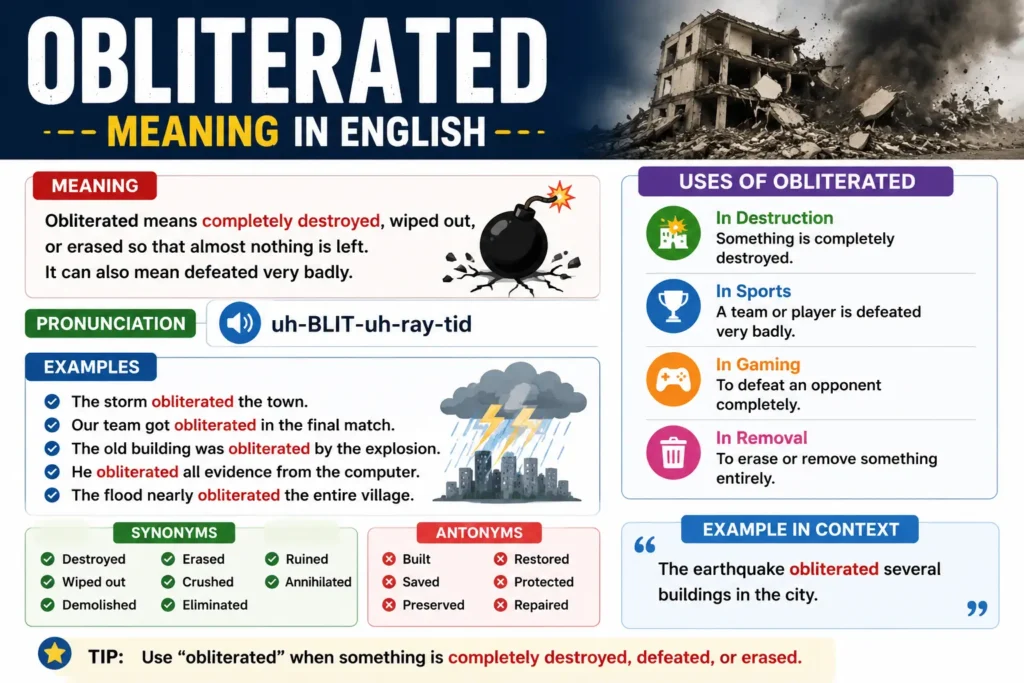
Have you ever heard someone say something was “obliterated” and wondered what that actually means?
The word obliterated is powerful and dramatic. It is commonly used when talking about something being:
- Completely destroyed
- Wiped out
- Removed entirely
- Defeated badly
People use obliterated in:
- Movies
- News reports
- Sports
- Gaming
- Everyday conversations
In this guide, you’ll learn:
- The exact meaning of obliterated
- Easy examples
- Pronunciation
- Different uses
- Synonyms and FAQs
What Does Obliterated Mean?
Obliterated means completely destroyed, erased, or removed.
It can describe physical destruction, emotional impact, or total defeat.
👉 Example:
“The old building was obliterated by the explosion.”
This means the building was completely destroyed.
Obliterated Meaning in Simple Words
In simple English, obliterated means something was destroyed so badly that almost nothing remained.
It can also mean:
- Defeated completely
- Removed entirely
- Forgotten or erased
Obliterated Pronunciation
The word obliterated is pronounced as:
👉 uh-BLIT-uh-ray-tid
Obliterated Meaning With Examples
Example 1
“The storm obliterated the town.”
👉 Meaning:
The storm completely destroyed the town.
Example 2
“Our team got obliterated in the final match.”
👉 Meaning:
The team lost very badly.
Example 3
“He obliterated all evidence.”
👉 Meaning:
He completely erased or removed the evidence.
Obliterated Sentence Examples
- The fire obliterated the entire house.
- The champion obliterated his opponent.
- Years of history were obliterated during the war.
- The mistake obliterated his chances of winning.
- The flood nearly obliterated the village.
Obliterated Meaning in Gaming
In gaming, obliterated often means:
👉 Completely defeating another player or team.
Example:
“We obliterated them 10–0.”
Obliterated Meaning in Sports
In sports commentary, obliterated describes:
👉 A one-sided victory or total domination.
Example:
“The team obliterated their rivals.”
Obliterated Meaning in News
News channels often use obliterated for:
- Natural disasters
- Explosions
- Large-scale destruction
👉 Example:
“The earthquake obliterated several buildings.”
Obliterated Synonyms
Here are common synonyms of obliterated:
- Destroyed
- Wiped out
- Demolished
- Erased
- Eliminated
- Ruined
- Crushed
Obliterated Antonyms
Opposite words of obliterated include:
- Built
- Restored
- Protected
- Preserved
- Saved
Common Mistakes When Using Obliterated
❌ Using It for Small Damage
Obliterated means total or near-total destruction.
❌ Confusing It With Simple Defeat
Obliterated implies a very severe defeat.
❌ Overusing the Word
Because it is strong language, it works best for dramatic situations.
Obliterated Meaning for Kids
For kids, obliterated means:
👉 “Destroyed completely.”
Kid-Friendly Example:
“The toy castle was obliterated during the game.”
Obliterated Meaning in Medical
In medical terms, “obliterated” refers to the complete closure, blockage, or disappearance of a body structure such as a blood vessel, cavity, or canal. It often occurs due to disease, inflammation, or surgical procedures.
Examples:
- The artery was obliterated due to severe plaque buildup, restricting blood flow.
- Doctors noted that the sinus cavity had become obliterated after repeated infections.
- Scar tissue can sometimes obliterate normal anatomical pathways in the body.
Obliterated Meaning in Dentistry
In dentistry, “obliterated” describes the condition where a tooth’s pulp chamber or root canal becomes filled in or closed, usually due to aging, trauma, or calcification.
Examples:
- The dentist observed an obliterated root canal, making treatment more complex.
- Dental trauma can lead to pulp canal obliteration over time.
- X-rays showed that the tooth’s inner space had been completely obliterated.
Obliterated Meaning in Biology
In biology, “obliterated” refers to the removal, destruction, or complete loss of a structure, tissue, or feature during development or due to environmental factors.
Examples:
- Certain embryonic structures become obliterated as the organism develops.
- The habitat destruction obliterated several native plant species.
- Evolution may lead to organs becoming reduced or obliterated over time.
Obliterated Meaning in English
In general English, “obliterated” means to completely destroy, erase, or remove something so that it no longer exists or can be recognized.
Examples:
- The old building was obliterated by the explosion.
- Heavy rain almost obliterated the footprints on the ground.
- His memory of the event was completely obliterated over time.
Obliterated Meaning in Chinese
In Chinese, “obliterated” can be translated as 消灭 (xiāo miè) or 抹去 (mǒ qù), depending on context. It generally means to destroy completely or wipe out entirely.
Examples:
- The village was obliterated in the storm (村庄被完全消灭).
- Time has obliterated those memories (时间抹去了那些记忆).
- The evidence was obliterated from the records (证据被抹去).
Common Confusions, Mistakes & Wrong Interpretations
Some people misunderstand obliterated as:
“Just tired”
But it’s more than tired — it means completely destroyed or wiped out.
“Sad”
It can mean emotional pain, but not always.
“Angry”
It may show frustration, but not always anger.
Similar Terms, Alternatives & Related Slang
Here are some words people use instead of obliterated:
- Wiped out
- Destroyed
- Exhausted
- Crushed
- Blown away
- Shattered
Examples of “Obliterated” in Real Chat Situations
Here are short examples for quick understanding:
- After a long day:
“I’m obliterated 😴” - After a game loss:
“He obliterated me in that match 😭” - After emotional news:
“That story left me obliterated.”
How to Reply When Someone Says “Obliterated”
Here are some natural responses:
- “You okay? 😕”
- “Get some rest!”
- “That sounds intense.”
- “Same here, I’m exhausted too.”
- “Want to talk about it?”
Is “Obliterated” Still Popular? Trends & Online Usage
Yes, the word remains popular in online slang because it sounds dramatic and strong. It is often used for humor, shock, or to exaggerate emotions.
FAQs:
1. What does obliterated mean in slang?
It means completely wiped out, exhausted, or destroyed.
2. Is obliterated a good word to use?
Yes, but it’s strong and should be used in casual or dramatic contexts.
3. Can obliterated mean “dead”?
Not literally. It means destroyed or wiped out, not necessarily dead.
4. Is obliterated used in text messages?
Yes, commonly to show extreme tiredness or shock.
5. What is the opposite of obliterated?
Restored, saved, repaired, or intact.
Conclusion:
The obliterated meaning is strong, dramatic, and often used to show extreme emotion or exhaustion. While it originally referred to total destruction or erasing, today people use it in everyday chats to exaggerate feelings.
Just remember, it’s a powerful word and should be used in the right context to avoid confusion.
Next time someone says they are obliterated, you’ll know they mean they are completely drained, shocked, or emotionally affected. Use the word carefully and you’ll sound natural and confident in modern conversation.

Benjamin is a name that means “son of the right hand” in Hebrew. People with this name are often known for their intelligence, kindness, and strong character. Benjamin is usually curious and loves learning new things. He works hard in school and enjoys solving problems. He is also loyal to his friends and family, and people trust him because he is honest and helpful. As an adult, Benjamin may choose a career in science, business, or art, where he can use his skills and creativity. Overall, Benjamin is seen as a smart and reliable person.