
If you’ve ever received a text like “ILY 😘” from a friend, crush, or family member, you might have paused for a second and wondered, “What does ILY mean?”
In today’s digital world, abbreviations and slang like ILY have become a staple of online conversations. People search for it to understand messages quickly, avoid miscommunication, or just keep up with modern texting trends.
ILY is more than just letters—it’s an expression of emotion condensed into three simple characters. Whether you’re a social media enthusiast, a teen, or an adult trying to decode text messages, knowing the meaning and proper usage of ILY can help you respond appropriately and connect better with friends, family, and partners online.
What Does ILY Mean in Text & Chat?
ILY stands for “I Love You.” It’s commonly used in texting, messaging apps, and social media to express affection, care, or deep friendship. Unlike formal declarations of love, ILY is casual, quick, and easy to type, making it perfect for modern communication.
Some key points about ILY in texts:
- Casual affection: Friends often use it to show care.
- Romantic love: Couples use it to express love quickly.
- Family use: Kids and parents sometimes use it to send warm messages.
Quick examples:
- “Goodnight! ILY 😴❤️”
- “Thanks for helping me today! ILY 😘”
- “ILY! Can’t wait to see you!”
Despite its simplicity, the emotional weight of ILY can vary depending on the sender, the recipient, and the context. In group chats, it might be playful, while in private messages, it can feel deeply personal.
Full Form, Stands For & Short Meaning of ILY
The full form of ILY is straightforward:
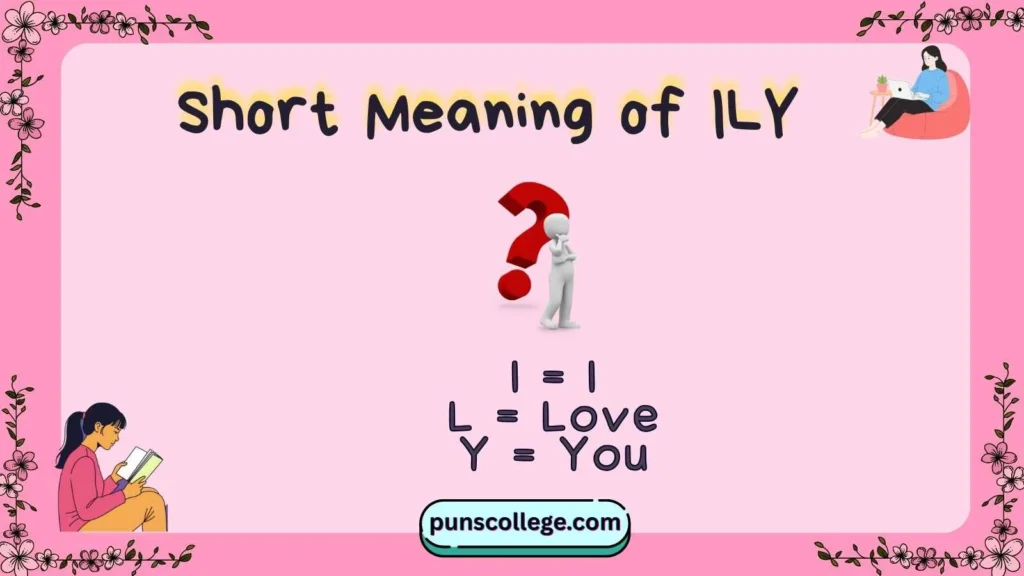
I = I
L = Love
Y = You
Shortly put, ILY = I Love You. 🥰
It’s often combined with other abbreviations or emojis for added emotion:
- ILYSM = I Love You So Much
- ILU = Another casual version of I Love You
- ILY2 = I Love You Too
The short meaning allows people to express love quickly in digital spaces without writing a long message. This convenience is why ILY has become a universal part of texting culture.
Pro tip: Using all caps (ILY) may feel more enthusiastic, while lowercase (ily) can seem casual or playful.
Origin, History & First Known Use of ILY
The exact origin of ILY is tricky to pinpoint, but it grew alongside texting culture in the 1990s and early 2000s. Early SMS messages had character limits, so users started abbreviating common phrases to save space. ILY became one of the most popular shortcuts for expressing love in a concise way.
- 1990s: Text messaging begins widely, leading to short forms like LOL, BRB, and ILY.
- Early 2000s: Social media platforms like MySpace and Facebook spread ILY further.
- Today: ILY is ubiquitous across platforms, including Instagram, Snapchat, and TikTok.
Some linguists also link ILY to internet shorthand culture, where brevity and speed are valued. Interestingly, ILY has transcended English, with many non-English speakers using it as-is because of its global recognition.
How People Use ILY in Daily Conversations
In everyday texting, ILY is versatile. Here’s how people commonly use it:
- Friends: “ILY BFF! 😎” (friendly love)
- Romantic partners: “ILY babe ❤️” (romantic affection)
- Family: “ILY Mom! Thanks for dinner 🍝” (family care)
- Casual flirting: “ILY 😏” (playful tone)
It’s important to note that context matters. A simple “ILY” can mean:
- Genuine love
- Casual appreciation
- Playful exaggeration
💡 Tip: Always consider the relationship and tone before replying to an ILY message.
ILY Meaning Across WhatsApp, Instagram, TikTok & Snapchat
- WhatsApp: Often used in direct messages and group chats for quick affection.
- Instagram: People use ILY in DMs, comments, or captions, often paired with emojis.
- TikTok: Creators include ILY in captions or trends to connect with fans.
- Snapchat: ILY streaks and snaps are common, sometimes showing love through images or Bitmoji.
Across all platforms, ILY remains a simple yet powerful way to communicate love and care quickly.
Different Meanings of ILY in Other Fields
While ILY almost always means “I Love You” in texting, it can occasionally have other interpretations in specific contexts:
- Aviation codes: ILY is the airport code for Islay Airport, Scotland.
- Medical acronyms: Rarely, ILY can appear in certain clinical notes but is context-specific.
- Gaming usernames or tags: Some gamers use ILY creatively as initials.
These uses are much less common, so in casual conversation, it’s safe to assume ILY = I Love You.
Common Confusions, Mistakes & Wrong Interpretations
People often mix up abbreviations like ILU, ILY, and ILYSM. Some mistakes include:
- Mixing up ILU and ILY: Both mean “I love you,” but ILU is slightly less common.
- Overusing ILY: Sending it too often can make it seem less sincere.
- Misreading context: Playful ILY in a group chat might be interpreted as serious love.
💡 Pro tip: Match your ILY usage to the tone of the conversation to avoid awkward misunderstandings.
Similar Terms, Alternatives & Related Slang
Some related abbreviations include:
- ILY2: I Love You Too
- ILYSB: I Love You So Bad
- LYLAS: Love You Like A Sister
- LYLAB: Love You Like A Brother
These variations add personality and specificity, depending on your relationship with the recipient.
Examples of ILY in Real Chat Situations

- Romantic:
- “ILY 😍 Can’t wait for our date!”
- Friendship:
- “ILY BFFR! You’re the best 💖”
- Family:
- “ILY Mom, thanks for helping me today 🥰”
- Playful:
- “ILY but stop stealing my fries 😏”
How to Reply When Someone Says ILY
- Romantic: “ILY too ❤️”
- Friendship: “Love you too, bestie 😘”
- Family: “ILY! Thanks for checking in 🥰”
- Playful: “ILY but I’m still winning 😎”
💡 Tip: Match the tone to show sincerity while keeping it natural.
Is ILY Still Popular? Trends & Online Usage
Despite the rise of new slang and emojis, ILY remains widely used across generations. On TikTok, Instagram, and Snapchat, it continues to appear in trends, captions, and memes.
- Younger generations: Often mix ILY with emojis and creative variations.
- Older users: Stick to traditional ILY in texts and calls.
Overall, ILY has staying power due to its simplicity, emotional impact, and universality.
FAQs:
Q1: What is the difference between ILY and ILU?
A: Both mean “I Love You,” but ILY is more widely used.
Q2: Can ILY be used for friends?
A: Yes! ILY is often used for friendly affection too.
Q3: Is ILY appropriate in professional chats?
A: Generally, no. Stick to formal language in work settings.
Q4: What does ILYSM mean?
A: I Love You So Much, an intensified version of ILY.
Q5: How should I reply to ILY?
A: Match the tone: “ILY too,” “Love you too,” or playful alternatives.
Conclusion:
ILY may be short, but it carries a big emotional punch. Whether you’re texting a friend, family member, or significant other, understanding ILY ensures your messages are read with the right intention.
Its simplicity, universality, and ease of use make it one of the most popular abbreviations in modern communication.
Next time you see ILY, you’ll know exactly how to interpret it—and how to respond with warmth, humor, or affection. In the fast-paced world of digital communication, mastering simple expressions like ILY keeps your relationships strong and your chats heartfelt. 💌

Benjamin is a name that means “son of the right hand” in Hebrew. People with this name are often known for their intelligence, kindness, and strong character. Benjamin is usually curious and loves learning new things. He works hard in school and enjoys solving problems. He is also loyal to his friends and family, and people trust him because he is honest and helpful. As an adult, Benjamin may choose a career in science, business, or art, where he can use his skills and creativity. Overall, Benjamin is seen as a smart and reliable person.